
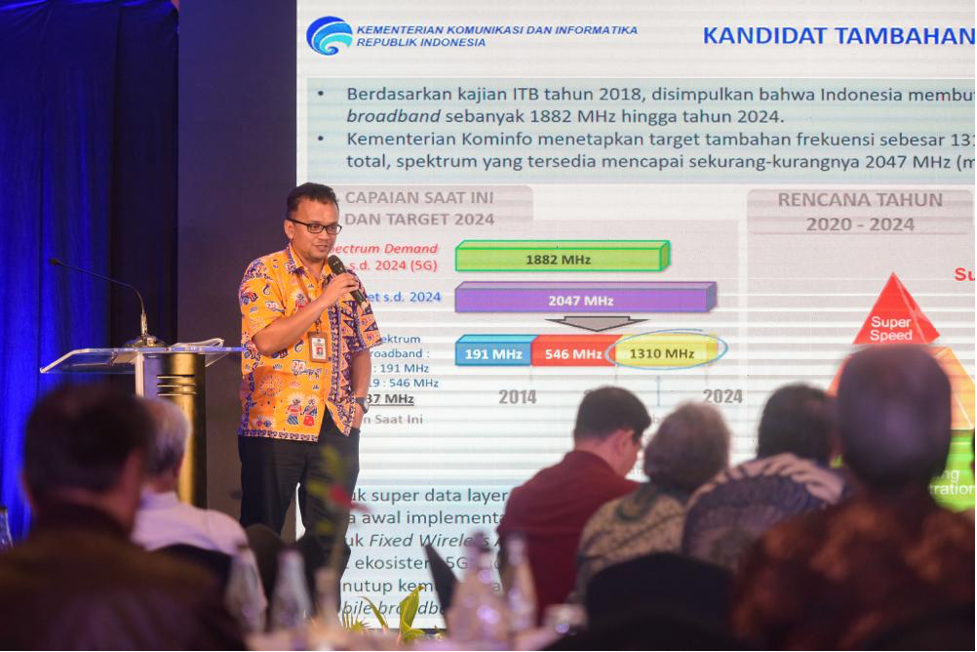
Jakarta, Kominfo – The Global Supplier Association reported that until the end of February 2020, there were 63 operators in 35 countries who had commercialized 5G technology. Meanwhile, telecommunication operators, including those that have invested in piloting and are currently under construction, there are 359 operators who wish to take advantage of new technologies that can provide faster access with low latency (delay).
According to the Executive Director of the Indonesia ICT Institute, Heru Sutadi, joint discussions with all stakeholders are needed, because the adoption and implementation of 5G cannot go alone and individually. “There are three main things that need to be put forward, namely business, technical and regulatory. Before 5G is implemented, we are ready. Readiness here is the development of the ecosystem,” he said at the Indonesia 5G Ecosystems Forum 2020, Tuesday (10/3/2020).
Several operators in Indonesia have currently carried out a series of trials using 5G technology. However, there are many things that telecom sector stakeholders should discuss for the adoption and implementation of 5G technology.
When delivering his keynote speech, the Director General of Resources and Equipment of Post and Information Technology, Ministry of Communication and Information Technology, Ismail explained about the evolution of technology from 4G to 5G. The focus of 4G technology is the experience for the user, while in 5G it is not only for the user, but also the connectivity between devices.
“If 2G, 3G becomes 4G, the focus is on user experience, increasing internet capabilities or speed. Users will get something special when switching generations. But in 5G, not only user experience, but also massive machine connectivity. 5G tries to connect device to device, from the internet of things and the internet for things, all communicating with each other,” he explained.
The strategic policy to solve 5G problems, he continued, is the end-to-end ecosystem. Among other things, about the choice of technology, the economics of 5G, and geostrategy. Next, infrastructure must be prepared at all layers. “This can and should have started now. I see that our fellow operators have moved quite a distance through the fiberization process of their respective networks,” said Ismail.
Meanwhile, according to the Director of Resource Management of the Directorate General of SDPPI, Denny Setiawan, 5G without fiber optics is like vegetables without salt. “The optical fiber-based backbone needs to continue to accelerate its penetration to the residential level and evenly, not only concentrated on the island of Java. It is necessary to internalize the spirit of nationalism that telecommunication operators are development agents, because penetration requires collaboration,” he said when he was a panelist at the discussion session.
In the same forum, Deputy Mayor of Tegal Muhamad Jumadi welcomed the government’s efforts to build a 5G ecosystem. “We have an interest in how digital technology can be used to create a smart city. The city of Tegal is currently actively building and providing services to the community with the latest technology. Hopefully with 5G, the City of Tegal as The Real Smart City can be realized,” he said.
The Indonesia 5G Ecosystem Forum was attended by the Ministry of Communication and Informatics along with the Indonesian Telecommunications Regulatory Agency as a regulator in the telecommunications sector, the Telecommunications and Information Accessibility Agency (BAKTI) which has completed the construction of the Palapa Ring, telecommunication operator associations, IoT associations and also academics.
https://www.kominfo.go.id/content/detail/25003/35-negara-sudah-komersilkan-5g/0/artikel