
Press Release No.114/HM/KOMINFO/04/2021
Wednesday, April 7, 2021
About
Support for Comprehensive 5G Governance, Minister Johnny Describes 5 Policy Aspects
5G technology is currently the most advanced broadband telecommunications technology, considering that many countries in the world have launched the commercialization of services based on 5G technology.
According to the Minister of Communications and Informatics Johnny G. Plate, Indonesia is in the preparation stage to provide quality 5G services for the community, as well as for the growth of the economic sector. Therefore, a comprehensive management is needed.
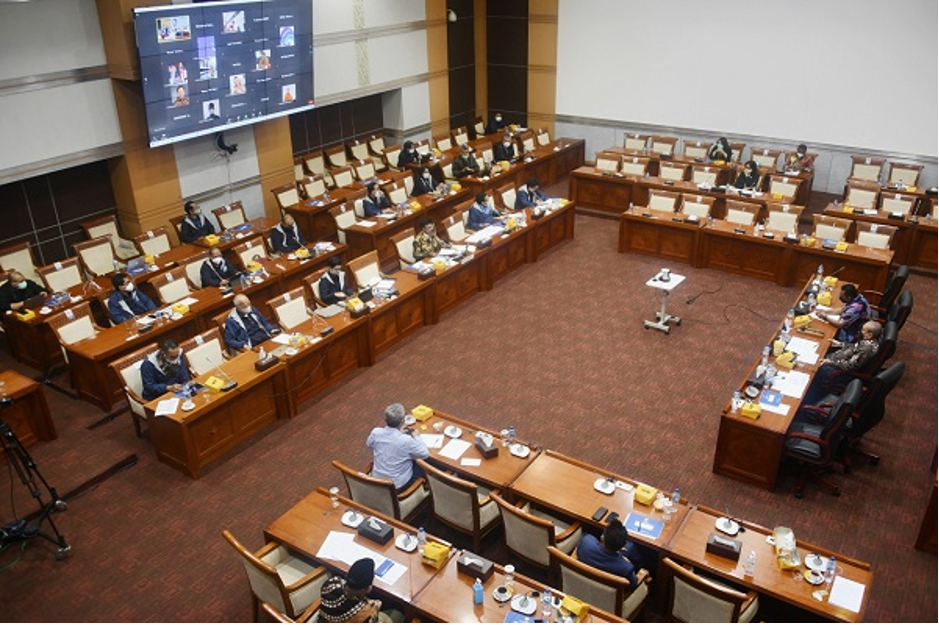
“The Ministry of Communications and Informatics believes that in an effort to implement and develop quality 5G services, synergy is needed from at least five policy aspects,” he said in a Working Meeting with Commission I DPR RI in the Commission I Meeting Room, DPR-RI Building, Senayan, Jakarta, Wednesday (07/04/2021).
The five aspects include regulatory aspects, radio frequency spectrum, business model, infrastructure, as well as equipment, ecosystem, and digital talent.
“With comprehensive policy support, 5G services that will be present in Indonesia in the near future are expected to be able to provide the maximum benefit to the people, nation and state of Indonesia, especially in the economic sector,” he explained.
For the regulatory aspect, Minister Johnny said the implementation of 5G services in Indonesia is supported by at least eight (8) regulations that are quite up-to-date and flexible, namely:
#1 Law No. 36 of 1999 concerning Telecommunications;
#2 Law No. 11 of 2008 as amended by Law no. 19 of 2016 concerning Information and Electronic Transactions (UU ITE);
#3 Law No. 11 of 2020 concerning Job Creation;
#4 PP No. 52 of 2000 concerning Telecommunications Operations;
#5 PP No. 53 of 2000 concerning Use of Radio Frequency Spectrum and Satellite Orbit;
#6 PP No. 46 of 2021 concerning Post, Telecommunications, and Broadcasting (commonly referred to as PP Postelsiar);
#7 Draft Law (RUU) on Personal Data Protection (RUU PDP), and
#8 Regulation of the Minister of Communication and Informatics as its implementing rule.
“These regulations complement each other. As an illustration, the existence of the Electronic Information and Transactions Law (UU ITE), and the Personal Data Protection Bill (RUU PDP) will later be needed by the public to ensure the protection of personal data, data traffic security, and data sovereignty, ” he said.
Synergy between these regulations is needed considering that data growth in the 5G era will be more abundant, one of which comes from the massive deployment of sensors from Internet of Things (IoT) services.
According to Minister Johnny, the Job Creation Law has also provided a fairly comprehensive regulatory component to support 5G development later, because it regulates several points.
“The first is the coexistence of over-the-top (OTT) services, especially between mainstream conventional services and new services from newcomers; OTT like Youtube, Facebook, Twitter, Instagram, and others. Second, setting tariffs so as to create favorable and affordable tariffs through setting ceiling prices and/or floor prices,” he said.
Another thing that is also regulated in the Job Creation Act is cooperation in the use of radio frequencies for new technologies, such as the Global System for Mobile Communication Railway (GSM-Railway) for fast train signaling and 5G for broadband Internet purposes).
In addition, infrastructure sharing policies for both active and passive infrastructure, determining the deadline for the implementation of analog-switch-off (ASO) on November 2, 2022, and optimizing the value of benefits in the 700 MHz radio frequency band.
SFR and Business Model
The second governance support is the Radio Frequency Spectrum (SFR). Minister Johnny stated that to ensure optimal deployment of 5G networks, Indonesia requires frequency spectrum allocation in at least three layers.
“That is at the Low Band level which includes frequency bands below 1 Giga Hertz, Middle Band which includes frequency bands in the 1-6 Giga Hertz range, and also in the High Band (which is often referred to as Super Data Layer or millimeters). Wave Band), which covers high frequency bands above 6 Giga Hertz,” he said.
In relation to the management of the radio frequency spectrum as a limited natural resource, the Government of Indonesia through the Ministry of Communications and Informatics has implemented two policies in order to optimize its utilization for the community. The two policies are technology neutral and the Frequency Farming and Refarming program.
As for the business model, the Minister of Communication and Information assessed that the presence of 5G technology in people’s lives will trigger many changes in business models, both in the telecommunications industry and other vertical industries such as manufacturing and automotive.
“This is because the potential for 5G services no longer only focuses on patterns of communication between humans (human-to-human), but also integrates humans with machines (human-to-machine), and creates communication networks/lines between one machine and another (machine-to-machine). ),” he explained.
The Minister of Communication and Informatics explained that 5G services for human-to-human communication can increase human interaction through various digital platforms, such as virtual/augmented reality, video conferencing, and social networks to improve public security.
“5G technology will also seem to eliminate boundaries in human-to-machine interaction, for example by realizing smart home, smart city, and tele-health technologies. Then with the creation of machine-to-machine communication, changes in business models will be increasingly felt with the development of industrial automation in order to adapt to the Industrial Revolution 4.0 and artificial intelligence (AI) technology,” he said.
Fiberization and Infrastructure Strengthening
According to Minister Johnny, to support the deployment of 5G services, fiberization and comprehensive infrastructure strengthening are needed. This can be done at least through three main things.
“First, in the 5G era, the Base Transceiver Station (BTS) type will be dominated by the short BTS-BTS type, but the placement is very tight, which is called the small cell. Therefore, easy access to existing passive infrastructure is needed, such as street lights, traffic lights, billboards, bus stops, and so on,” he said.
In addition to the BTS type, efficiency and regularity in urban planning also require shared space in the form of ducting as an arterial route for the distribution of Fiber Optic (FO) networks, both to BTS, houses, buildings and public facilities. “These two main things require intensive and comprehensive socialization to all elements at the local government level, so that harmonious steps occur so that 5G is able to become an enabler of Indonesia’s progress, starting from the regions,” he explained.
The third thing is that fiberization efforts need to be accelerated by telecommunications operators so that inter-BTS connections and middle-mile/backhaul networks have a large transmission capacity and are able to provide responsive connections, and are able to anticipate increasingly exponential traffic growth.
The last aspect, namely regarding support for comprehensive 5G governance, is devices, ecosystems, and digital talent. The Minister of Communication and Information believes that 5G must provide opportunities and opportunities for domestic potential.
“Of course, the presence of 5G technology in Indonesia must provide opportunities and opportunities for potential in our own country. Starting from the TKDN (Domestic Content Level) aspect of 5G devices, we continue to synergize with the Ministry of Industry to formulate the most appropriate policies, such as 40% TKDN 4G,” he explained.
The Minister of Communication and Information added that base station devices through open protocol technology, such as Open RAN technology (Radio Access Network) have been initiated through a research collaboration between Telkom University and one of the leading global vendors in the Open RAN technology ecosystem. In addition, there are 5G handset types with a TKDN value of at least the same as the TKDN value for 4G handsets, which is 30%. In this regard, an intensive study involving the Ministry of Industry and domestic industrial business actors is expected to continue.
“All of these efforts lead to our common goal, which is to encourage Indonesia to become a producing country, at least components,” he said.
According to the Minister of Communication and Informatics, 5G network development is not only an infrastructure, but also as an effort to build a local ecosystem, especially ecosystems at the application layer. Therefore, the development of this application ecosystem needs to be improved, considering that since the 4G era, Indonesia has proven to be able to host in its own country through a number of local applications that have turned into unicorns and even decacorns.
“These local applications, including IoT applications, are expected to continue to dominate so that they can compete with applications or OTT from outside Indonesia. Community-based empowerment must continue to be improved so that local industry activists are more competent in producing and developing application-based businesses,” he said.
In terms of human resources, the Minister of Communications and Informatics assessed that the development of digital talent with a 5G perspective needs to be carried out comprehensively. This can be started from the preparation of digital talent on the upstream side through formal education as a manifestation of the role and duties of universities to educate the Indonesian people to excel and be competitive.
“The role of talent development at the upstream level is carried out by the Ministry of Communication and Information through the development of the Multimedia College (STMM) in Yogyakarta. Currently, STMM Yo
gyakarta focuses on three majors, namely Animation and Design, Public Information Communication, and Broadcasting,” he explained.
Since opening acceptance to the public in 2001 until now, STMM Yogyakarta has accepted a total of 5,007 students and graduated 2,285 alumni. The Ministry of Communications and Informatics is committed that in the future STMM Yogyakarta will strive to metamorphose into the National Digital Institute (IDN), a Center of Excellence in the digital field that includes four major new study clusters.
“These include digital technology, digital communications and media, the digital economy, as well as digital governance and policies. This metamorphosis is carried out to maintain relevance to the times, and moreover to prepare Indonesian human resources to be ready to face digital disruption,” he said.
In addition to STMM Yogyakarta, the Ministry of Communication and Information has also contributed to the development of digital talent on the downstream side through the Digital Talent Scholarship (DTS) program which was initiated in 2018.
“This program is planned to not only increase the number of participants, but also to enrich the curriculum with appropriate skills for the 5G era, for example Open RAN software development, system integrator training, 5G network governance, advanced computing, understanding cyber security, networking, and programming. ” he added.