
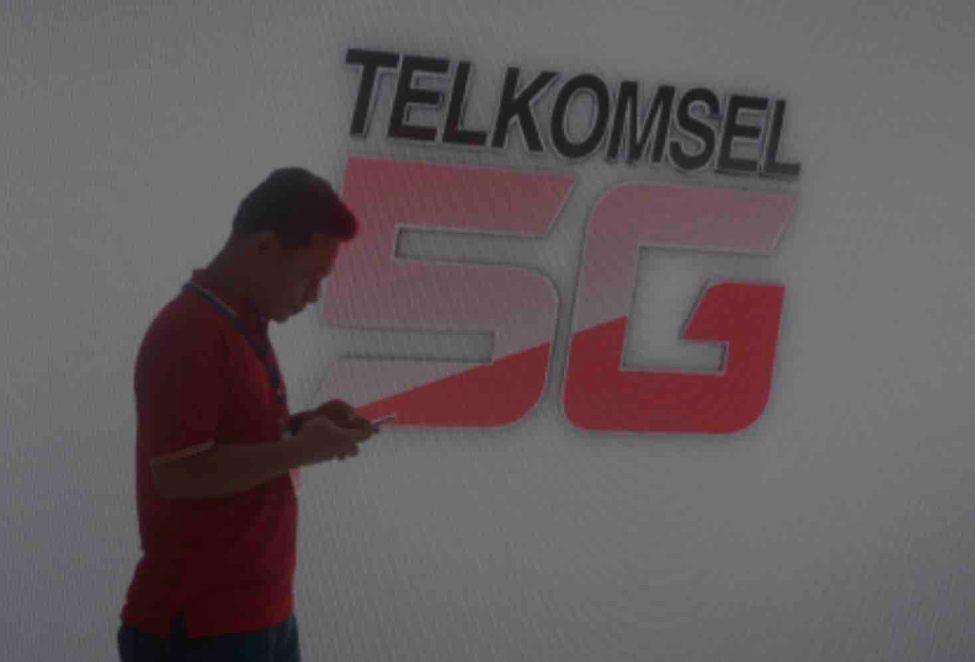
Indonesia is entering a new phase of information technology. Since Monday (24/5/2021), 5G cellular networks have started operating commercially throughout Indonesia. The 5G mobile cellular network which operates for the first time is based on IMT-2020 (International Mobile Telecommunications-2020) technology in the 2,300 MHz or 2.3 GHz frequency band.
When inaugurating this network service, the Minister of Communication and Information (Kominfo) Johnny Gerard Plate stated that the operation of the 5G cellular network was the result of the work of the government and telecommunications operators as well as a form of accelerating digital transformation in Indonesia.
Prior to its launch, the Ministry of Communications and Informatics together with several telecommunications operators had conducted 12 5G network trials throughout 2017 to 2020.
“One of the trials was carried out during the 2018 Asian Games. In early 2021, the Ministry of Communication and Informatics has also conducted an auction for the 2.3 GHz frequency band,” explained Minister Johnny.
This 5G network service also marks the stage of simultaneous operation of 4G and 5G in the country. Thus, the presence of 5G services does not necessarily displace 4G services that have been used by the community. The reason is, in the initial development stage, a 4G network is also needed as the basis for 5G operations.
As a new technology, the 5G network will certainly further encourage the advancement of Indonesia’s digital sector. To be sure, 5G services are faster and have a larger network capacity as well as reliable than 4G networks. In addition, 5G technology will open up service potential not only for human-to-human communication, but also integrate human-to-machine networks and machine-to-machine communication networks.
In order to optimize 5G services, Indonesia requires frequency spectrum allocation in at least three layers, namely low band, middle band, and high band. 5G technology is a very flexible technology. This means that the technology can be applied to types of Mobile Broadband or Fixed Broadband or Fixed Wireless Access (FWA) services.
The frequency bands in the low band and middle band layers, such as the 700 MHz, 2.6 GHz, and 3.5 GHz bands, are more suitable for use as 5G Mobile Broadband services. Currently, 5G Mobile Broadband will be prioritized in 5G development in Indonesia.
The Ministry of Communication and Informatics is also seeking 5G Fixed Broadband services according to world standards, namely by utilizing spectrum bands at the high band layer, such as the 28 GHz frequency band which has a large transmission capacity.
The Ministry of Communications and Informatics has issued a Certificate of Operation Eligibility (SKLO) for 5G Services to PT Telkomsel as its first provider. The issuance of the SKLO is based on the implementation of the Operational Feasibility Test (ULO) on 19 to 20 May 2021. Based on the ULO results, PT Telkomsel was declared operationally eligible after the Ministry of Communications and Informatics conducted technical testing of PT Telkomsel’s facilities and infrastructure in operating the 5G network.
Digital Transformation
5G technology is believed to be able to accelerate social, economic and cultural transformation digitally. One of the advantages of the 5G network is its high data transfer speed and low latency.
The implementation of the 5G network is predicted to be able to provide a fast, smooth, and even instant video streaming and downloading experience. Even though Indonesia is still in the 4G era, the demand for streaming and downloading videos has increased sharply from the consumer side.
This condition is reflected in the Covid-19 pandemic in the past year, where internet network usage has soared by up to 300 percent. The results of the 2020 Global Web Index Survey further emphasize the demand for video content consumption from consumers. 51% of Gen Z prefer online video content for their media consumption, while 31% choose online TV.
Meanwhile, 64% of customers are more likely to buy a product online after watching a video about the product. This is the main reason why e-commerce giants such as Shopee, Tokopedia, and Lazada prefer to promote their products through online video marketing.
Meanwhile, global information and communication technology provider Huawei sees the use of 5G networks as experiencing rapid development, especially when many industries have begun to adopt the technology.
By 2020, at least 140 commercial 5G networks were deployed in 59 countries and more than 50 percent of those networks were built by Huawei. The use of 5G applications as part of core production processes in industry has begun to bloom in 2021. 5G applications have been applied in more than 20 industries, including manufacturing, healthcare, education, and logistics. One of them is being used as a logistics loading and unloading automation system in one of the busiest airports in the world, Yanshen Port, Shanghai. 5G technology can significantly reduce logistics costs at ports.
In Indonesia itself, the government together with digital industry players have begun to prepare devices and ecosystems when the 5G network is implemented in smart cities, manufacturing industries, e-commerce, health, and logistics.