
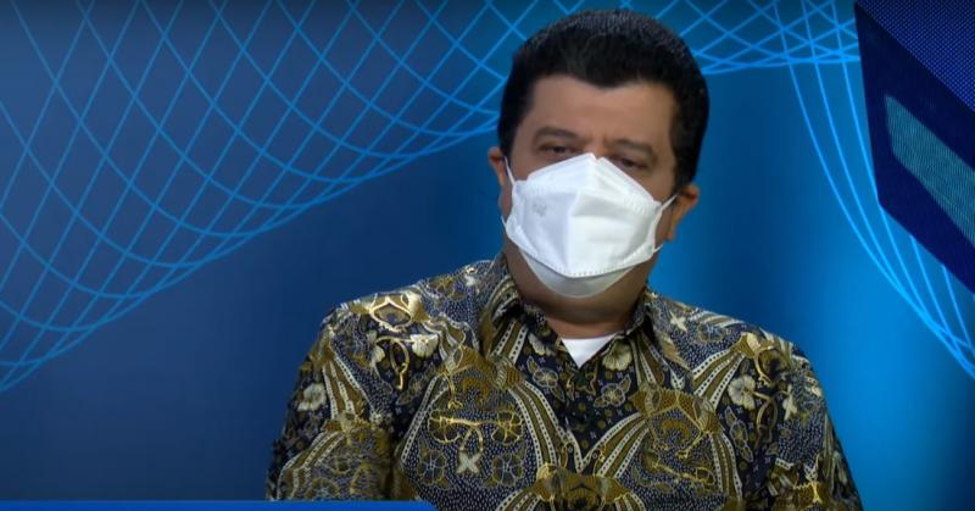
Jakarta, Kominfo – The Association of Indonesian Telecommunication Providers (ATSI) assesses that the availability of fiber optic infrastructure in the application of 5G technology is a must. Therefore, the role of the Ministry of Communications and Information Technology needs to be improved in the provision of fiber optics.
Secretary General of the Association of Indonesian Telecommunications Providers (ATSI), Marwan Baasir explained that when testing and launching 4G in the 2014-2015 period, the process of rolling out a new technology took time, especially from 4G to 5G.
“This is a fairly fundamental difference. Transport in 4G can still use microwaves or microwaves. Because what is running in today’s society, maybe it’s the same with operators, it can use more than 50-60 percent of the microwave. By switching to 5G, whose speed is above 10 gigabytes, we need fiber optics. So, fiber optics are a must. Otherwise, 5G will feel like 4G, because the transport is lacking. So, that’s what is really needed, “explained Marwan in a discussion at the Merdeka Barat 9 Forum ( FMB9) on Monday (07/06/2021).
Marwan added, the availability of fiber optics is still limited, because it is only available in big cities. For this reason, the role of the Ministry of Communication and Informatics must be optimized to assist operators who are members of associations, so that local governments can relax their rules so that the process of deploying fiber optics can run easily so that they can support 5G development in the country.
Marwan said, the ideal 5G is at a frequency of 3.5 giga hertz (gH). Currently, operators are using existing frequencies, so some are using 2.3 gH. This is because the use of the 2.3 GHz frequency is still possible with dynamic spectrum sharing.
“It’s still 5G, it only uses the existing spectrum, so the current bandwidth is still limited. So, we hope that 3.5 GHz can be fast,” said Marwan.
In addition, in applying 5G technology, operators other than Telkomsel also need to be given equal treatment. “So even if they use the existing frequencies, namely 1,800 and 2,100 with DSS, I am sure the government will push for the Operational Feasibility Test (ULO) to be immediately obtained by operators. One of the operators who have proposed DSS is Indosat,” he said again.
Currently, continued Marwan, the public will be introduced to 5G with the existing frequencies. At least people can experience 5G first. This is because there are still a number of obstacles and challenges for operators in providing 5G.
The constraints and challenges in question are, First, it is clear Spectrum. Both Fiber Optic are not yet fully integrated.
“So, fiber optics need to be evenly distributed. Moreover, in deploying fiber optics, of course, the operator rents it to the regional government, provincial government, central government. The hope is of course to get an affordable price as mandated in the Omnibuslaw Law. Now how do we ensure the tools of the Act are implemented until to the regions. Because, don’t forget that in Indonesia there are quite a lot of local governments, which maybe the procedures for implementing the law are also different. This is of course an obstacle that must be faced, “said Marwan.
Third, make sure this 5G application is running. “I’m worried, don’t let us upgrade technology to 5G, but its use is only for internet access. This is of course very unfortunate,” said Marwan.