
Press Release No. 162/HM/KOMINFO/12/2020
Thursday, December 10, 2020
About
Kominfo Prepares Policy to Encourage 5G Network Acceleration
The Covid-19 pandemic has emphasized how the world is changing rapidly, including encouraging the acceleration of the digital transformation process in Indonesia. Bank Indonesia data indicates that up to August 2020 there were 140 million total e-commerce transactions in Indonesia.
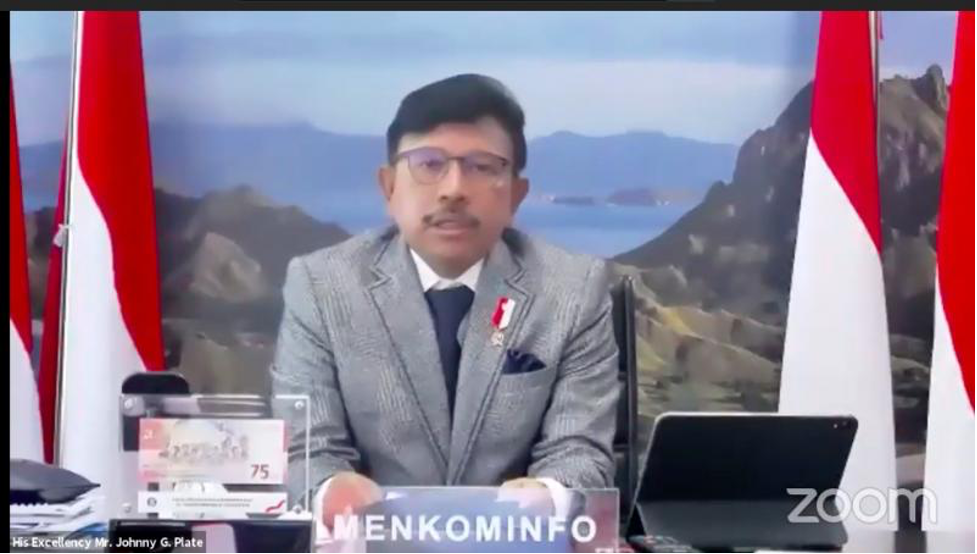
Minister of Communications and Informatics Johnny G. Plate said this progress also affected Indonesia’s information and communication technology (ICT) sector. One of them is the need to prepare for the implementation of a 5G network that will become the backbone of digital transformation in Indonesia.
“Which has also remained strong despite the pandemic, with double-digit growth at 10.83% in the second quarter and 10.61% in the third quarter of 2020 year-on-year, as reported by the Central Statistics Agency (BPS),” he said. when delivering a keynote speech at the International Virtual Conference: Indonesia 5G Roadmap & Digital Transformation, from Jakarta, Thursday (10/12/2020).
Minister Johnny stated, the 5G network will be a game changer or game changer with a broad impact on connectivity in Indonesia. It has even become the backbone of digital transformation and the main driver of economic growth.
“We believe that we must work hard to carry out our great task of adopting new technologies, to increase our productivity through 5G networks in the near future,” he stressed.
According to the Minister of Communications and Informatics, currently digitalization and connectivity have had a major influence in increasing equality of opportunity, access and inclusion, and 5G will accelerate it.
“The Indonesian government has initiated several policies and affirmative actions to accelerate the introduction of 5G in Indonesia,” he stressed.
Minister Johnny emphasized that the Ministry of Communication and Informatics took advantage of this momentum to reduce the existing digital divide. “Using this momentum, the Ministry of Communications and Informatics through the Telecommunication and Information Accessibility Agency (BAKTI) is working hard to bridge the digital divide that exists in Indonesia,” he said.
According to the Minister of Communication and Informatics, to date the Indonesian government has built more than 348,000 kilometers of land and underwater fiber optic cables. Including more than 12,000 kilometers of the Palapa Ring National Fiber Optic Backbone Network BAKTI Kominfo.
“Indonesia has also built more than 500,000 base transceiver stations (BTS) and utilized 9 satellites to meet domestic needs for adequate connectivity. In addition, we also plan to launch the 150 Gbps High-Throughput Satellite SATRIA-1 which is scheduled for the third quarter of 2023,” he explained explaining the development of ICT infrastructure in Indonesia.
Minister Johnny stated that the development effort was part of the preparation for the development of 5G networks in Indonesia.
“We continue to improve the digital infrastructure, including in all villages that have not been reached by 4G connections. However, the main task of ensuring adequate, accessible and affordable 4G as a basis for developing a 5G network remains relevant,” he said.
The Minister of Communication and Informatics emphasized that the Indonesian government is currently working to accelerate the 5G spectrum allocation initiative. This effort is considered important to meet the need for a 2,047 MHz frequency spectrum for the use of broadband cellular networks, both 4G and 5G in 2024 at all layers.
“It is very important to plant and re-grow 5G spectrum to meet the demand for the 2,047 MHz frequency spectrum. Existing and new candidate bands in the coverage layer (below 1 GHz): 700/800/900 MHz. Then the capacity layer (between 1-6 GHz): 1.8 / 2.1 / 2.3 / 2.6 / 3.3 / 3.5 GHz, and the super data layer (above 6 GHz): 26/28 GHz,” he explained.
IKN is a Candidate for 5G Implementation
Minister Johnny stated that the Indonesian government had conducted 10 trials of implementing the 5G network during 2017-2019. The trial is aimed at studying the potential applications and use cases of 5G services.
“Such as remote learning through holographic interaction, remote operation, IoT for smart cities, and autonomous vehicles during the ASIAN Games. 2018. In 2020, Indonesia will focus on its 11th trial to explore the possibility of coexistence between 5G networks and Fixed Satellite Service (FSS) for use in the 3.5 GHz band,” he explained.
In addition, according to the Minister of Communications and Informatics, Indonesia is trying to optimally utilize microwave links as a second option after fiber optic cables. “Because the very high E-band (70-80 GHz) and V-band (60 GHz) frequencies can also serve high-capacity backhaul for broadband services,” he said.
Minister Johnny realized that efforts to implement a 5G network would require large capital expenditures, especially for the provision of 5G small-cell densification and a sophisticated digital ecosystem. Therefore, the Minister of Communication and Informatics stated that
The new capital city of Indonesia will be the best and potential candidate city to implement the first 5G in Indonesia.
“Apart from several industrial areas and public areas with high traffic that may also be possible,” he said.
Four Pillars
The Ministry of Communication and Information is currently supporting the acceleration of digital transformation through four comprehensive pillars. The first pillar is deploying a stronger and more inclusive digital infrastructure, secondly increasing digital literacy and human resources as a means to improve and retrain Indonesia’s digital talents.
“The third pillar is adoption of technology advocates, and the fourth major legislation in the ICT sector. including through the completion of the Personal Data Protection Law (GDPR),” said the Minister of Communications and Informatics.
According to Minister Johnny, the last regulatory pillar reaffirms the view of the Indonesian government regarding data sovereignty. All of these pillars and principles are considered important to build a conducive digital ecosystem.
“Despite the importance of the first three pillars, the regulatory pillar emphasizes the need to enforce and improve data sovereignty, including cross-border data flows based on the principles of transparency, validity, fairness and reciprocity. Based on these principles, together we can build a digital ecosystem that is conducive to innovation and investment,” he said.
In the introduction to the conference, the Minister of Communication and Informatics emphasized the seriousness of the Indonesian government to create breakthroughs in encouraging innovation. This is shown by the ratification of Omnibus Indonesia on Job Creation in the form of the Job Creation Law: Law no. 11 Year 2020.
“The Job Creation Act will also allow telecom operators to share spectrum for advanced technologies such as 5G, which will create ultimate efficiencies coupled with passive share. infrastructure and active network,” he said.
All these steps in the view of Minister Johnny are the key to encourage the development of 5G networks in Indonesia.
“The implementation of agile and flexible regulatory measures is needed as a major breakthrough to support an inclusive and competitive digital environment and encourage the launch of 5G networks in Indonesia,” he said.
Sharing experiences
The Minister of Communications and Informatics hopes that all participants can share insights, data and experiences to utilize 5G technology in accelerating digital transformation, especially in developing countries such as Indonesia.
“Thank you to all the speakers and participants who discussed important themes that became a concern when I first served as minister. I hope the speakers can share insights, data, and experiences about the power of 5G technology to accelerate the nation’s digital transformation, especially developing countries like Indonesia,” he said.
Minister Johnny appreciated the speakers who represented the global ICT community. “We are fortunate to be able to gather a great lineup of speakers who represent the global ICT community, starting from representatives of ITU, GSMA, GSA, ATSI and of course from the Ministry of Communication and Informatics represented by Dr. Ismail, the Director General who is responsible for the management of critical and limited natural resources in the 2nd century: the radio frequency spectrum,” he said.
Before ending his remarks, the Minister of Communications and Informatics quoted the Latin phrase, per aspera ad astra, through difficulties to the stars. “Among the stars in the sky rests our great natural resource, the radio spectrum that requires our hard work to utilize and optimize it,” he said.
Therefore, the Minister of Communications and Informatics invites all stakeholders to collaborate, and work hand in hand for the implementation of 5G. “Through strong cooperation, I believe that the difficulties in implementing 5G will be overcome, and the 5G network will make Indonesia jump to a big leap in transforming Indonesia as a smart country. For Advanced Indonesia, Become a Star!” he said.
The event, which was held by the Ministry of Communication and Informatics, brought together representatives of the 5G Industrial Global Ecosystem and Indonesian telecommunications companies.